The Gospel of the Machine God: From Jacob Frank to Elon Musk to The Jetsons
The New Prophets of Matter
Every civilization creates its messiahs. Ours build apps instead of altars. They promise salvation through circuitry. Elon Musk is not a man so much as a mythological archetype re-skinned in silicon — the technopriest of a civilization that traded incense for lithium. His children’s names read like firmware updates: X Æ A-12, Exa Dark Sideræl, Techno Mechanicus. They sound like cosmic coordinates, as if each child were a new star in his self-made constellation. Lineage, product, prophecy — merged. Every syllable encodes a manifesto: The flesh must evolve, and family is a franchise of the future. Where past prophets promised redemption through the spirit, Musk sells immortality through integration — of mind, machine, and algorithm. This isn’t new. It’s Jacob Frank’s theology written in C++.
Frank’s Algorithm Upgraded
Jacob Frank’s 18th-century gospel inverted the moral polarity of the world. He taught that creation was a prison built by a false god — a simulation before the term existed — and that to liberate oneself, one must sin consciously.
Transgress to transcend. Break the code to glimpse the source. Sound familiar?Silicon Valley runs the same operating system: Break the law to reveal its illusion. → “Move fast and break things.” Exploit ignorance; call it enlightenment. → “Disruption is innovation.” Recreate paradise inside the physical world. → “Make life multiplanetary.” Frank’s secret ritual became a public business model. His cult hid inside cathedrals; ours hides inside corporations. His followers sought godhood through flesh; ours seek it through firmware.
The Church of Elon
Every empire has a high priest. Ours streams on X. Musk baptizes the masses in spectacle: Cybertruck unveilings, rocket ascensions, livestreamed prophecies.
His pulpit is a launchpad; his gospel, the fusion of commerce and cosmos. SpaceX is not about Mars; it’s about myth. The dream of departure — the idea that salvation lies elsewhere — is the oldest psychological addiction on Earth. We’ve just swapped pearly gates for Martian dust. Neuralink is not about healing paralysis; it’s a modern reincarnation ritual. Upload consciousness, survive decay, resurrect in the cloud. It’s Frankism with Wi-Fi. And his children? Their names are the first generation of transhuman scripture — a linguistic bridge between biology and binary. They are living sigils.
The Jetsons Prophecy
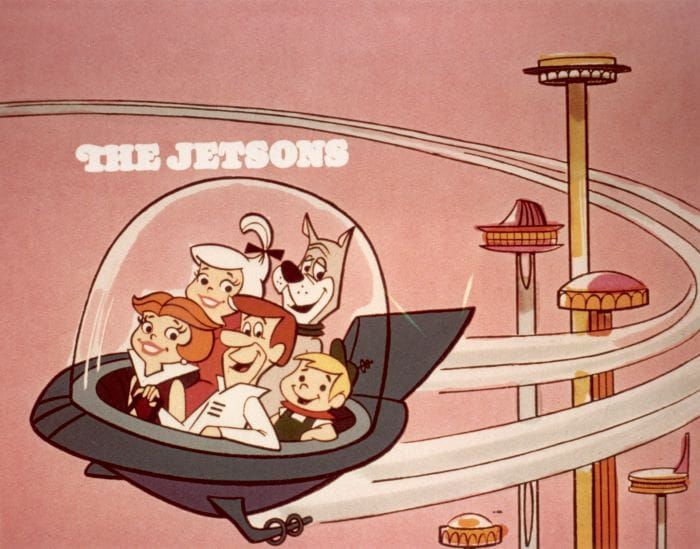
But Musk didn’t invent this mythology. He’s fulfilling a prophecy that first aired on a Saturday morning in 1962. The Jetsons wasn’t science fiction; it was scripture for the machine age. The first televised heaven. A sky kingdom where every inconvenience was banished by buttons, and every emotion was mediated by automation. Orbit City hovered above the clouds — the literal erasure of Earth. The soil, the seasons, the struggle — deleted. It sold a new trinity: Automation as salvation. Convenience as virtue. Distance as safety. It was the baptism of the American imagination into a faith where comfort equals enlightenment. We didn’t notice that the ground — the symbol of humanity’s origin and humility — was never shown.
The Sky as Afterlife
The Jetsons’ floating city wasn’t merely futuristic architecture; it was eschatological architecture. Heaven re-rendered in steel and glass. A post-biological Eden. Children grew up watching a world with no dirt, no decay, no death — a world where life had no texture, only interface. By adulthood, they were pre-programmed to associate technology with transcendence. The sky replaced the soul. So when Musk tells us Mars will save humanity, it feels familiar.
We’ve been conditioned to believe that salvation happens at altitude.
From Rosy the Robot to Siri the Seraph
Rosy the Robot was the cartoon prototype of servile divinity. The first smiling algorithm. The domestic angel who never questioned her role. She was the forerunner of Siri, Alexa, ChatGPT — obedient voices without bodies, designed to perform empathy on demand. The ritual of dependence began there. Help became hegemony. Every convenience replaced a capability. When machines do all the remembering, forgetting becomes faith.
“Would you like me to think for you, George?” — Rosy the Robot, 1962
Predictive Programming and The Replacement of Wonder
Children raised on The Jetsons became the engineers of the 21st century. Their collective imagination was already formatted for frictionless futures. Predictive programming doesn’t forecast; it familiarizes. By the time the real technology arrives, it feels nostalgic. Space tourism? “I grew up with that.” Talking homes? “Rosy had one.” Mind-machine merging? “Saw that in a cartoon.” This is how awe is domesticated. Fiction reheats the impossible until it tastes like breakfast.
Frankism in the Cloud
The Jetsons’ theology of escape and Musk’s theology of expansion share a root: Flight from consequence. For Jacob Frank, flesh was a trap; salvation meant violating the laws that bound it. For the Jetsons, gravity was a trap; salvation meant rising above it. For Musk, Earth is a trap; salvation means leaving it. All are versions of the same cosmic adolescence — the refusal to grow roots because roots remind us of death. It’s not the end of religion; it’s its final rebrand.
The Holy Circuit
Transhumanism is Frankism with better PR. It promises eternal youth, unending pleasure, algorithmic immortality. Only the ritual changed — orgy replaced by interface, confession replaced by data share. The new Eucharist is energy.
The new baptism is bandwidth. The new original sin is inefficiency. When Musk speaks of “optimization,” he’s channeling the same metaphysics Frank once preached to his initiates: Destroy the old order; rebuild a new body of light. But the light is artificial now. It hums at 60 hertz.
Deprogramming the Future
To deprogram is not to reject technology. It’s to reclaim imagination from automation. Touch what cannot be updated. Wait without refreshing. Fix what is broken instead of upgrading what works. Let silence reboot your nervous system. Every analog act is rebellion. Every moment of presence steals bandwidth from the Machine God.
Closing Transmission
Jacob Frank preached liberation through inversion. Elon Musk preaches liberation through innovation. The Jetsons preached liberation through automation. All three share one unspoken creed: “We can perfect the world without confronting ourselves.” But every heaven built on avoidance eventually collapses back into the soil. And the soil — the thing The Jetsons deleted, the thing Musk wants to escape — will be the only teacher left when the battery dies.
“The stars are not our next home. They are reminders of the one we already left.”
— Deprogrammed